
A guide to help you prepare for your appointment. Read it whenever you’re ready, and reach out with any questions.
Before Your Visit: A Checklist
- Make a parking spot available as close to your pet as possible with a clear path
- Choose a comfortable place for your pet and for you to be
- Have plenty of your pet’s favorite treats or food ready
- Put on some soft music, if you’d like
- Keep our number handy (text or call): 608-909-0002
What should I do to prepare for the visit?
If you’d like, here are a few things you can do to prepare for the visit:
- Parking – If we will be moving your pet from your home to my vehicle, it helps to have a parking spot open as close to your pet as possible, with a clear, direct path. If you’re able to move your car out of the closest spot for the length of the appointment, it is very appreciated.
- Location – Think about where you would like to be with your pet: on their bed, the couch, your bed, or anywhere else you all feel comfortable. There are really no restrictions. If possible, please position yourselves so that I can reach your pet’s back end to give the medications.
- Heat – We all love being outside with our pets, and they love it too. On warm days, though, please keep in mind that sedated pets can’t regulate their body temperature and can overheat very easily, which can lead to panting and rapid breathing while they are asleep. I recommend a shady, cool spot if possible, or staying inside if it is cooler there.
- Ambience – Soft music can be very calming. I’ve found it helps lower stress for both people and pets, and it makes you less likely to be distracted by the sounds of me preparing medications. I usually set up in a spot close enough that I’m available if you need anything, but out of sight so you can have privacy with your companion. Low lighting can be lovely, but I will need a well-lit spot to prepare, as well as good lighting for the intravenous injection (think of how much light you would want to thread a tiny needle).
- Food and treats – If your pet still has an appetite, I strongly recommend having something really tasty to offer during the first injection, so they focus on the good food instead of what I’m doing. Please have plenty on hand, handfuls or a whole bowl rather than a single treat, so they can really chow down. The first injection is given slowly so it isn’t a shock, and it can take a little time. Wouldn’t you love to fall asleep right after eating the most delicious thing you can think of? On that note, anything goes, both on the day of the visit and during the appointment: ice cream, chocolate, cheeseburgers, fries, all of it is okay. If your pet doesn’t have an appetite, that’s okay too. Talking to them, petting them, and giving them scratches is wonderful, and the more focused they are on you, the less they will notice me or the injection.
Will you ring the doorbell when you arrive?
Absolutely not, since I know this can make pets overexcited. I will usually let you know when I’m on my way so you know when to expect me. When I arrive, I’ll let you know with a light knock at the door or a text.
Can we be outside? In a park?
Yes, absolutely. If the weather is cold, just give me a heads-up so I can be prepared to work outside. I sometimes use my vehicle to prepare, both to keep medications at room temperature and to have a sturdy surface to get everything ready. If you would prefer to be at a park or somewhere else other than your home, just let me know. That is absolutely fine.
What will happen after the sedative is given?
The sedative is given as an injection, usually under the skin between the shoulders or in a back leg, wherever is easiest for your pet. Your pet will start to get sleepy after about 2-5 minutes, and the sedative takes about 5-10 minutes to have its full effect. At that point your pet will be in a deep sleep, completely sedated, and not feeling anything, with no pain or sensitivity. I check for this by gently squeezing between the toes, where pets are usually sensitive. Your pet will be peaceful and relaxed, not feeling or seeing anything, but they can still hear you if you talk to them. The sedative includes butorphanol (a morphine-like medication), acepromazine, tiletamine, and zolazepam.
How “asleep” will my pet be with the sedation?
The sedation from the first injection is similar in depth to the sedation given before surgery. This deep level of sedation isn’t because the second injection is painful. It’s because I place a tourniquet and shave a small area on the leg before the IV injection, and I don’t want your pet to feel any of that.
Will my pet’s eyes close when they are sleeping and sedated? What about afterwards?
No, your pet’s eyes will most likely stay open for the entire process, from the sedative through the second injection and afterwards. This can be hard to see, but please know that they are asleep and unaware. Keeping the eyes closed takes muscle effort, and when pets are completely relaxed, their eyelids relax too, so the eyes stay open.
You may also notice your pet’s tongue come out while they are sedated. This simply means they are completely relaxed. Their breathing may change, for example rapid, shallow breaths followed by deeper ones. They might snore, vocalize, or have some muscle twitching. All of this is completely normal. Every animal is different, so there’s no way to predict which of these, if any, you might see.
Why is my pet panting after the sedative? Are they in distress?
No, they are not in distress. After the sedative, your pet may go through different breathing patterns, some slow, some fast, and sometimes panting. This doesn’t mean they are uncomfortable. It’s simply their body adjusting to the anesthetic. Depending on what is going on internally, I can’t predict exactly how their breathing will change, but it will most likely go up and down. If you ever feel that your pet is struggling to breathe, I will be right there to help.
How long does it take for the second injection to have its effect?
Once the IV catheter is in place and the second injection begins, things move fairly quickly, usually within 1-2 minutes. Depending on the pet, they may peacefully pass before the full syringe has been given, but I will still give the entire dose. The medication is an overdose of pentobarbital, which gradually slows the nervous system until all body processes stop.
Occasionally, veins can be hard to access or very fragile. This can happen in very elderly pets, pets with systemic disease, or pets with low blood pressure. Sometimes the first vein I try will collapse, and I will need to use another vein, in the other back leg or a front leg. There’s no way to predict when this might happen, but I have extensive experience using alternate veins. It’s nothing to be concerned about; it’s just something that can happen.
What will I see as my pet is passing?
Usually you will see your pet’s breathing change. There may be a few rapid breaths and a few deeper breaths, which become smaller and slower before stopping. Breathing stops first, and then the heartbeat gently fades. You may see muscle twitching even after the heart has stopped. This is just tense muscles releasing their stored energy. Occasionally a pet may take a few breaths even afterwards, and this is also a normal part of the process.
Will my pet go to the bathroom?
Sometimes pets do go to the bathroom during or after the procedure. This is normal and natural, but it doesn’t always happen. Just in case, I will bring an absorbent pad to place underneath your pet.
Will this be stressful for my pet?
Every pet is different. Some get excited when they see new people, but overall this is much less stressful than a visit to a clinic. Your pet will be in their own surroundings, and I will do everything I can to make this a peaceful experience for everyone, from beginning to end. Often when I arrive, adrenaline kicks in and your pet may get up, run around, bark, hide, or wag their tail, and this can make you question your decision. This is very common. It isn’t a sign of what their daily life is like, and I understand that. I feel it’s a blessing that pets can still be their normal selves and have a little burst of energy. It does not mean you are making the wrong choice. Remember that this is a gift you are giving them: choosing how the end of their life will be, at home and surrounded by love, the way we would all want it if we could choose.
Will my pet feel pain?
No, your pet will not feel any pain. They will only experience falling asleep at home, with you, surrounded by love. In rare cases you may see things under the sedative that look like pain, such as panting or vocalizing, but these are not signs of pain, and your pet is not aware of what their body is doing.
How will you know my pet has passed?
I will confirm that your pet has passed by listening carefully with a stethoscope. You are welcome to listen for yourself, or to place your hand over your pet’s heart. When the heart has stopped beating, death is confirmed. I use doses of both medications that are much larger than what is actually needed, so there have been no instances of a pet waking up again, and you can feel completely confident in the confirmation.
What if I feel that I need more time at a certain point in the process?
This process will go at your pace and your pet’s pace. I schedule appointments so that I’m never in a hurry and there is plenty of time. A visit usually takes about 30-45 minutes. If you need more than an hour, I will let you know that I can either come back at a later time or will need to move on to my next appointment. I usually move slowly and steadily, depending on how your pet is doing. If things feel too fast or too slow, please tell me. I am here only to help you and your pet, so don’t hesitate to speak up if you’d like anything done differently. If at any point you need more time, even afterwards, that is completely understandable, and I am here to honor your wishes.
I know this is likely one of the hardest days you will ever have, and you are at your most vulnerable. My only goal is to make the process peaceful, loving, and kind, giving you and your pet the respect and dignity you both deserve. Please don’t apologize for tears or for being unable to “hold it together.” I have been through this with my own pets, and I know this is not a time when you have to be strong. You don’t have to put on a brave face, have a clean house, or make small talk. You only need to focus on your beloved companion. Everyone experiences this differently. Sometimes you may feel a sense of relief that you were able to help your pet and spare them suffering. Sometimes you get through the visit okay and everything sets in later. All of this is okay. I know what it’s like: a mix of pain, love, grief, release, and more. Please give yourself grace to feel whatever you feel. It is all normal, understandable, and part of the process.
What keepsakes will we receive? Can we make our own prints?
Every visit includes a few keepsakes to help you remember your companion. At the time of service, I make a paw print impression for you, and I also include a lock of your pet’s fur, a memorial stone, and seeds to plant in their honor. If you would like additional prints, Trusted Journey Cremation Service can make clay paw print impressions as well as ink paw or nose prints for an additional fee. You are also welcome to make your own. Many families make prints after the sedative has taken effect and their pet is asleep, or afterwards. Print kits are available on Amazon and elsewhere. For nose prints, make sure the nose is as dry as possible. For paw prints, trimming the fur between the toes can give a cleaner print. There are also services that can turn a photo into a print.
How will we move our pet to your vehicle afterwards?
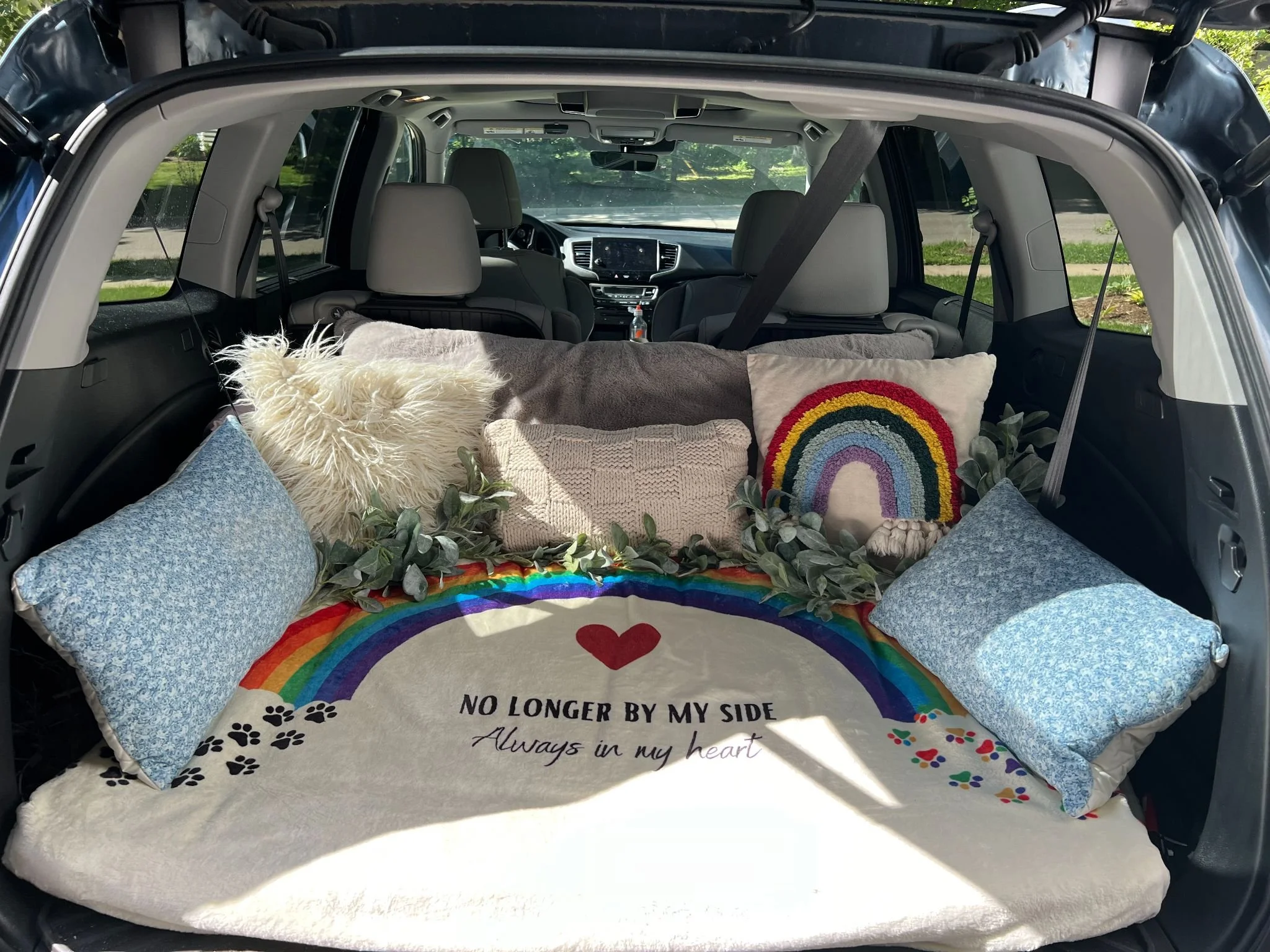
I will bring either a soft stretcher with handles or a basket to carry your pet to the back of my vehicle for transport to the cremation facility. I can carry pets up to 30 lbs on my own. For pets between 30 and 90 lbs, I will need one family member to help, unless I have an assistant with me, which is the case for most visits. For pets over 90 lbs, I will need two additional people to help. Many families feel this is a loving extension of the process, like serving as pallbearers for their companion. I will usually wrap your pet in a blanket that I bring and then move them onto the stretcher. For larger dogs, it helps to have them lie on a blanket ahead of time, before they fall asleep. I will have a cozy bed set up in the back of my car. Here is an idea of what that looks like:
Where does my pet go after they have passed?
After the visit, I coordinate right away with the cremation facility, and I either deliver your loved one to the crematorium or they pick them up from me.
What if we would like to bury our pet at home?
That is absolutely okay. Just let me know before the visit so I can plan accordingly. Your family will still receive the same keepsakes, and I am happy to answer any questions about next steps. A EuthaBag is also available for home burial for an additional fee, which is based on your pet’s weight. It is a soft, dignified body bag designed to respectfully hold and carry your pet. You can learn more at euthabag.com. If you are considering home burial, please check any local rules that apply where you live.
How do I know I’ll get my pet’s ashes back?
I have worked closely with Trusted Journey Cremation Service for over 10 years. They have earned a loyal following among pet owners and veterinary clinics through many years of loving, compassionate service and careful attention to detail. Your pet is identified from the moment I leave your home until the moment you receive everything back. A system of tags and barcode labels, which you likely won’t see, keeps each pet identified throughout the process and cared for as if they were our own.
How will I get my pet’s ashes back?
Your pet’s ashes are returned directly from Trusted Journey Cremation Service. You can choose to have them delivered to your home by mail, which is included in the cost of services, or you can pick them up in person at Trusted Journey’s location in Poynette. When your pet’s ashes are ready, Trusted Journey will reach out to you directly. Once your pet is in the care of the cremation service, I don’t have control over the exact date and time of the cremation, but we are always happy to help if you have any questions along the way.
I hope this has answered your questions about the process, including the ones we hear most often. Please don’t hesitate to reach out with any other questions or concerns. You can text or call us at 608-909-0002 or email info@fullcirclepet.com. That is what we are here for, and we look forward to talking with you so that you feel completely comfortable with the process.
Thank you so much,
Dr. Carrie Donahue